
In the rapidly evolving landscape of the digital workplace, the debate between artificial intelligence (AI) and human efficiency has become increasingly relevant. As businesses strive for greater productivity, cost-effectiveness, and innovation, the question arises: who truly holds the edge in the modern workforce—AI or humans? This article explores the strengths, limitations, and future implications of both entities in the context of digital work environments.
The rise of AI has transformed the way organizations operate. From automating repetitive tasks to analyzing vast datasets in seconds, AI systems offer unparalleled speed and precision. Machine learning algorithms can detect patterns, predict outcomes, and even make decisions based on historical data. This has led to significant improvements in areas such as customer service, logistics, finance, and marketing. Chatbots, for example, can handle thousands of customer inquiries simultaneously, providing instant responses and freeing up human agents for more complex issues.
However, Prediksi Bola efficiency is not solely defined by speed or volume. Human workers bring a unique set of qualities to the table—empathy, creativity, ethical reasoning, and emotional intelligence. These traits are especially valuable in roles that require nuanced judgment, interpersonal communication, and strategic thinking. While AI can generate content, it lacks the ability to understand cultural context, humor, or the emotional undertones that make human communication rich and meaningful.
One of the key advantages of AI in the digital workplace is its ability to work 24/7 without fatigue. Unlike humans, AI systems do not require breaks, sleep, or motivation. This makes them ideal for tasks that demand constant monitoring or real-time responsiveness. For instance, cybersecurity systems powered by AI can detect and respond to threats instantly, minimizing damage and ensuring business continuity. In contrast, human analysts may take longer to identify and address such issues, especially outside regular working hours.
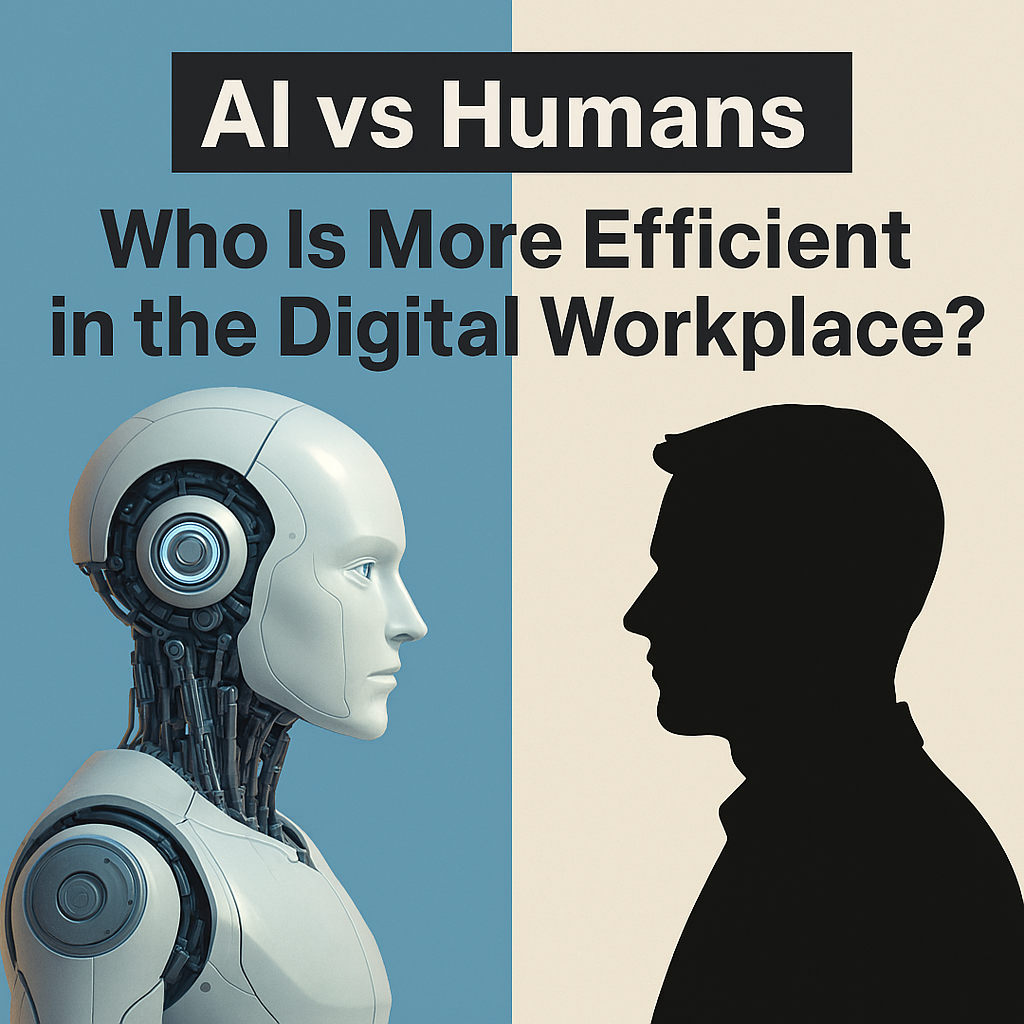
Despite these advantages, AI is not without its limitations. It relies heavily on data quality and quantity. Poor or biased data can lead to inaccurate predictions and flawed decision-making. Moreover, AI lacks the ability to adapt to unexpected situations that fall outside its training parameters. Humans, on the other hand, excel in improvisation and problem-solving under uncertainty. They can draw from experience, intuition, and social cues to navigate complex scenarios that AI might misinterpret or fail to address.
The integration of AI into the digital workplace also raises ethical and social concerns. Job displacement is a major issue, as automation threatens to replace roles traditionally held by humans. While some argue that AI will create new jobs and industries, the transition may be difficult for workers whose skills are no longer in demand. Reskilling and upskilling programs are essential to ensure that the workforce remains relevant and competitive in an AI-driven economy.
Another consideration is accountability. When AI systems make decisions—such as approving loans, diagnosing medical conditions, or recommending legal actions—who is responsible if something goes wrong? Unlike humans, AI cannot be held morally or legally accountable. This creates a gray area in governance and regulation, prompting calls for transparency and oversight in AI development and deployment Tang55.
Collaboration between AI and humans may offer the most balanced approach. Rather than viewing AI as a replacement, many experts advocate for augmentation—where AI enhances human capabilities rather than substitutes them. In this model, AI handles routine and data-intensive tasks, while humans focus on strategic, creative, and relational aspects of work. For example, in healthcare, AI can analyze medical images with high accuracy, but doctors interpret the results and make treatment decisions based on patient history and context.
The digital workplace is also witnessing the rise of hybrid teams, where humans and AI systems work side by side. This requires new forms of management, communication, and trust. Employees must learn to interact with AI tools effectively, understanding their strengths and limitations. Likewise, organizations must foster a culture that embraces technological change while valuing human contribution.
Training and education play a crucial role in this transformation. Workers need digital literacy, data fluency, and adaptability to thrive in AI-enhanced environments. Soft skills such as empathy, collaboration, and critical thinking are becoming more important than ever. Meanwhile, developers and engineers must design AI systems that are user-friendly, ethical, and aligned with human values Situs Slot Gacor.
From a business perspective, the efficiency of AI versus humans depends on the specific context and goals. In high-volume, low-variation tasks, AI often outperforms humans. In contrast, tasks that require emotional nuance, ethical judgment, or creative ideation are better suited for human workers. The challenge lies in identifying the right balance and leveraging the strengths of both.
Looking ahead, the digital workplace will continue to evolve. Emerging technologies such as generative AI, augmented reality, and quantum computing will further blur the lines between human and machine capabilities. Organizations that embrace this evolution with a thoughtful, inclusive approach will be better positioned to succeed Spaceman.
In conclusion, the question of who is more efficient—AI or humans—is not a matter of competition but collaboration. Each brings distinct advantages that, when combined, can create a more productive, innovative, and resilient digital workplace. Efficiency in the modern era is not about choosing sides, but about integrating strengths to achieve shared goals.